 Lewati ke konten






Pneumatic Buffing on VS Normal Buffing Edge Banding Machine: Full Differences Guide
When manufacturing high-quality wooden cabinets, wardrobes, and furniture, the edge buffing effect directly determines the final appearance grade and market value of finished boards.
Most standard edge banding machines on the market are equipped with normal fixed buffing systems or upgraded pneumatic swing buffing systems. Many furniture factory owners are confused about which buffing type is more suitable for mass production, high-gloss panels, curved edges, and premium veneer boards.
In this article, we will clearly explain the working principle, structural differences, polishing quality, failure rate, applicable board types, and production efficiency between normal polishing and pneumatic polishing for edge banding machines.
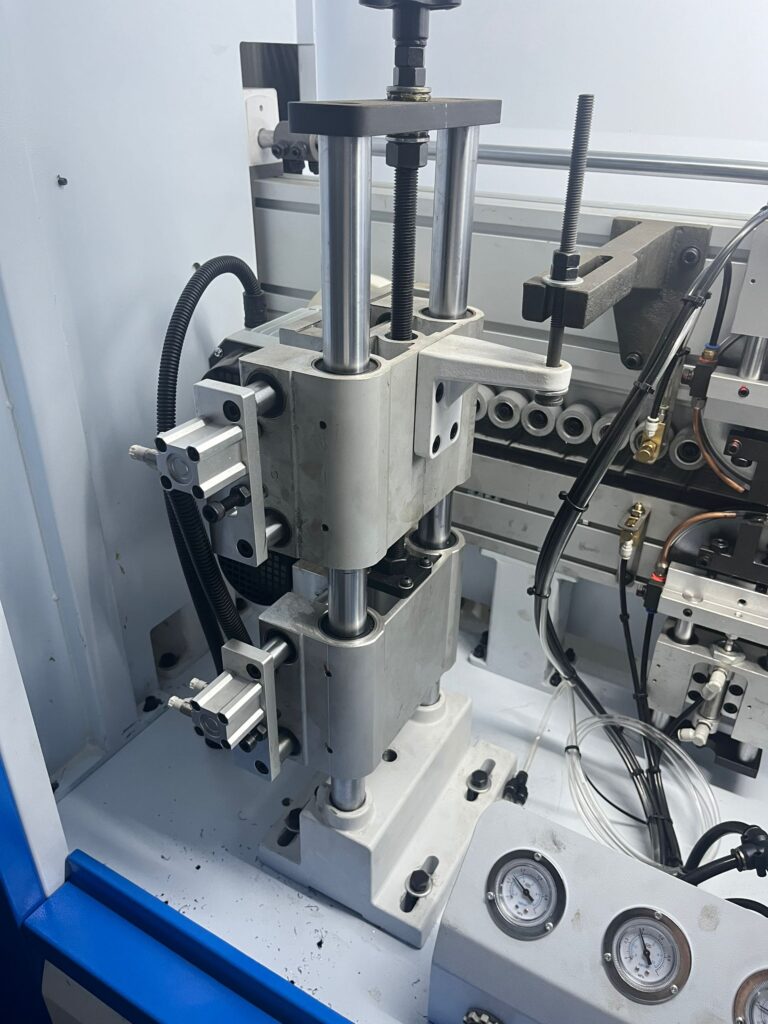
Pneumatic Buffing (Upgraded Version)
The pneumatic buffing system uses cylinder-driven automatic swing floating structure.
With stable air pressure control, the polishing wheels perform high-frequency reciprocating swing and floating compensation during edge banding processing.
It can automatically adapt to slight thickness errors, arc edges, curved corners, and uneven board surfaces. The air pressure system keeps constant polishing force without manual repeated adjustment.
Swing stroke covers full edge arc transition area (0–90°).
It removes tiny glue burrs and milling traces more thoroughly.
No dead corners, no linear marks.
High-gloss & melamine board finishing qualified rate reaches 98%+.
It reduces vibration by 45%–60%, greatly lowering surface damage risk.
• Automatic floating compensation, full-angle edge coverage
• Zero dead-corner polishing, super smooth edge transition
• Perfect for high-gloss board, melamine board, solid wood veneer
• Constant pressure polishing, extremely low scratch rate
• Reduce manual debugging time and board waste rate
Normal Buffing (standard)
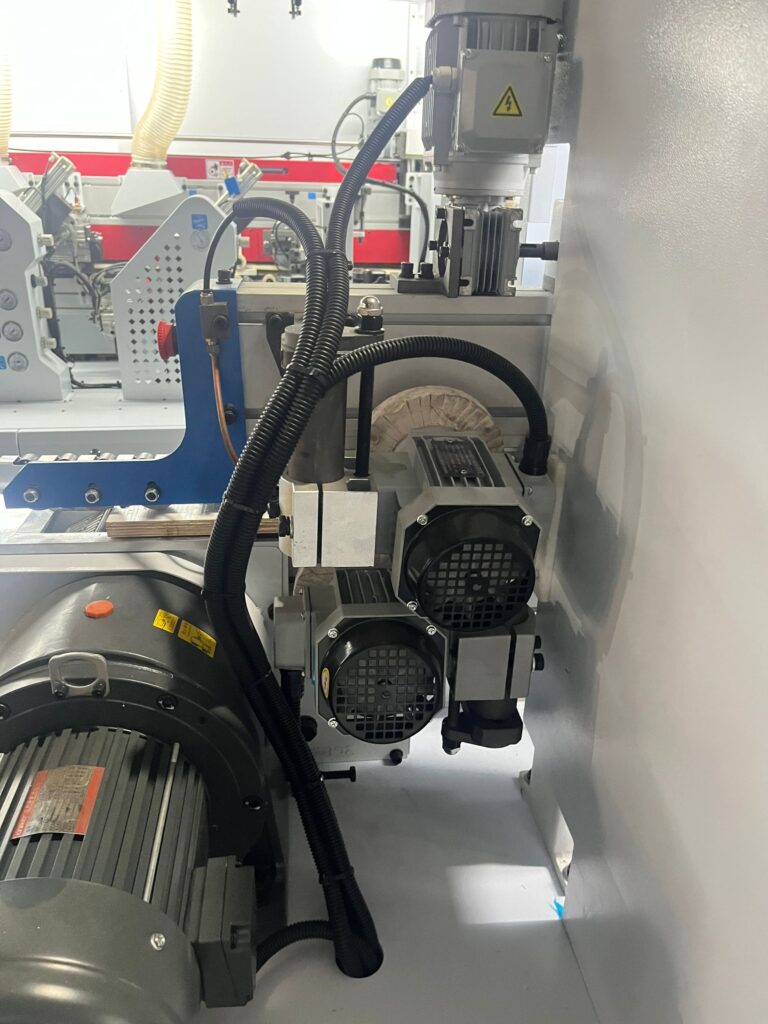
Normal buffing unit adopts fixed motor + fixed wheel position structure.
The two polishing motors are rigidly installed on the machine frame without automatic floating or swinging functions. During operation, the polishing wheels rotate at a fixed position and simply polish the upper and lower edges of the passing board.
It easily leaves visible linear polishing traces, glue line shadows, and dead corners on arc transition positions.
The qualified rate of high-gloss board finishing is only 82%–87%.
•Normal Polishing: Rigid contact. Slight board thickness deviation (±0.2mm) will cause insufficient polishing or over-polishing scratching the surface.
• Low machine cost and low maintenance cost
• Simple structure, easy operation for new workers
• Stable for low-standard ordinary board mass production
Final Summary
Normal fixed buffing is an economical and basic solution for standard edge banding tasks, suitable for low and medium-grade board production.
Pneumatic swing buffing is an upgraded high-precision finishing solution, featuring full-angle coverage, automatic error compensation, zero dead corners, and ultra-low defect rate. It is the standard configuration for modern high-end customized furniture production lines.
If you want to improve finished furniture quality, reduce rejection rate, and produce high-gloss mirror-level edge effects, upgrading to a pneumatic polishing edge banding machine is the most cost-effective improvement.
FAQ
Q1: Is pneumatic polishing necessary for edge banding machines?
A: It depends on your product positioning. For ordinary flat board production, normal polishing meets basic needs. For high-gloss, arc-edge, and high-precision furniture, pneumatic polishing is essential to avoid defective products.
Q2: Does pneumatic polishing require an air compressor?
A: Yes. The pneumatic swing system relies on stable air pressure drive. A standard industrial air compressor can support long-term stable operation.
Q3: Can pneumatic polishing completely remove edge glue lines?
A: Yes. The swing floating polishing enlarges the contact area, thoroughly removes tiny residual glue and milling traces, achieving invisible glue line effect on high-end boards.
Q4: Why do high-end furniture factories prefer pneumatic polishing?
A: It reduces board waste rate by 10%–15%, improves surface smoothness consistency, and makes edge transition more natural, greatly enhancing furniture market competitiveness.
Q5: Is pneumatic polishing easy to damage the board surface?
A: No. The air pressure buffer structure provides flexible constant pressure contact, avoiding rigid over-polishing scratches, safer than normal fixed polishing
